Friday, 16 August 2013

Discovering a dinosaur


Discovering a fossil is a wonderful experience and palaeontologists become really excited when they go on a fossil-hunting expedition (which doesn't happen that often - usually they stay at home, in a stuffy lab, studying fossils that are kept in the storage room of a museum). And their expeditions normally start when a member of the public finds an unusual specimen and alerts the experts. But before you go gallivanting across the countryside attempting to find the "next big thing", you need to know what it is you are looking for.


As can be seen in the above picture, there are usually large teams involved in digging up a dinosaur. This is because there is A LOT of work that needs to be done. You need people to dig large amounts of earth and rock (sometimes done with a machine if the fossil is deep enough), others need to remove small amounts of rock surrounding the fossil. You need a photographer to take pictures of the fossil and the surrounding area so researchers have a better idea of the rocks and the orientation of the fossil. And you need people to prepare the specimens for transport - this normally involves coating bones in plaster of paris and labelling them. In short, this isn't for people who prefer to work alone. You need people who know what they're doing.

(Grand Canyon, Arizona)

So, let's just say you are a palaeontologist and someone has presented you with a very impressive fossil. You have recruited all the relevant team members and you have arrived at the site. What's next? You need to know which rocks are more likely to harbour fossils than others. The best rocks for that are sedimentary rocks such as sandstones, mudstones, shales and limestones. Sometimes metamorphic rocks (rocks that have been shaped by intense heat and pressure such as slate) can contain fossils but they are often very distorted. Cliffs are really good places and it helps if they're by the sea because the water and wind will erode the outer layers of rock and expose the fossils underneath. This is why palaeontologists get really excited about a rockslide on the beach.


Unfortunately, many of the locations where fossils are found are very dangerous. As mentioned, they are normally found in areas prone to landslides and other effects of erosion and weathering. And though I've never tried it, I'm pretty sure the human body does like being thrown off steep cliffs. There is also an additional danger. Sometimes the land that fossils are found in are private and most people don't appreciate trespassers, especially if they are digging large holes everywhere. So remember, stay safe and always ask permission before you do anything. 

So they are my tips: gather a large team, look for sedimentary rocks, stay away from danger and obtain permission from any landowners. Next time, we'll look at what happens to the fossils when they get back to the museum or lab. In the next post, we'll look further into the man that gave us dinosaurs: Richard Owen

Monday, 5 August 2013

Heads up!


Dinosaurs are strange looking things aren't they? They resemble nothing that exists today. However, if we look closer, we can spot some similarities between them and living animals. In this post, we'll take a look a their skulls - what do they tell us about how dinosaurs lived?


First up is Prenocephale (Preen-o-sef-a-lee) (Sloped Head) (Maryanska and Osmolska, 1974). As can be seen in the picture, Prenocephale possesses a domed head. The function of the dome is a matter of much debate with ideas ranging from competition between males for mating (Colbert, 1955) to species or individual recognition (Goodwin and Horner, 2004).


Next is Troodon (Tro-o-don) (Wounding Tooth) (Leidy, 1856). The narrow, delicate jaw it possesses would indicate it is a carnivore. It has large, forward-facing eyes that helped it to gauge distances when hunting for prey. It's teeth, however, tells a more complicated story. To keep it short, there are two opposing views. That of Holtz et al. (1998), who believe Troodon to be omnivorous (based on the size and spacing of its denticles (small serrations on the tooth itself)) and Fiorillo (2008), who believes them to be entirely carnivorous (based on the large size of the teeth and their wear patterns). Now, you may have heard that Troodon is the most intelligent dinosaur based on its brain-to-body size ratio. We'll be looking at this claim in more detail later.


Next is Euoplocephalus (Yoo-Op-Low-Seff-A-Lus) (Well Armoured Head) (Lambe, 1910). Euoplocephalus has a wedge-shaped, squat head protected by spikes. It also has a short, wide mouth similar to a rhinoceros' with which it ate low-growing plants and shrubs. It's skull is very distinctive when compared to other ankylosaurs with relatively small, variably fluted teeth that lack a cingulum (a ridge at the base of the tooth), modified palpebrals (eyelids), shallow nostrils and the teeth of the upper jaw are curved towards the middle (Vickaryous and Russell, 2003). It also possessed bony eyelids, however, these are no longer regarded as being unique to Euoplocephalus (Coombs, 1972). However, despite this slew of defining characteristics it has recently been suggested that what we know of as Euoplocephalus is actually composed of four different genera namely: Euoplocephalus, Anodontosaurus (An-Oh-Dont-Oh-Saw-Us) (Toothless Lizard) (Sternberg, 1929), Scolosaurus (Sko-Low-Saw-Us) (Pointed Stake Lizard) (Nopcsa, 1928) and Dyoplosaurus (Die-Op-Low-Saw-Us) (Doubly-Armoured Lizard) (Parks, 1924). If this is the case, the distinguishing features of Euoplocephalus would become: absence of any ornamentation behind the eyes and, on the first armour ring of the neck, again no ornamentation and the osteoderms (bony scales) in the middle have a keel (in biology, ornamention is anything that serves as a display feature like spikes, horns, brightly-coloured feathers etc.) (Arbour and Currie, 2013). But we'll look in more detail on that later.


Finally, we have Styracosaurus (Stye-Rack-Oh-Saw-Us) (Spiked Lizard) (Lambe, 1913). Pretty impressive skull isn't it? There is a lot of variation amongst Styracosaurus individuals but they all seem to have had at least four large spikes on the frill. These spines could reach 50-55 cm long (Dodson, 1996). The large nasal horn, however, is probably not as big as depicted in this picture. The original specimen that Lambe used to described Styracosaurus had an incomplete horn. Lambe estimated that this horn was about 57 cm long. However, based on other material discovered since, the horn probably probably ended in a rounded tip about 20 cm long (Ryan et al., 2007). The function of the frill and horns has been debated about for decades. The ideas have been: attachment points for large jaw muscles (Lull, 1908); combat/defence (Farke et al., 2009); to regulate body temperature in a similar fashion to elephant's ears (Wheeler, 1978); and for sexual display (Farlow and Dodson, 1975).

So, as can be seen, dinosaur skulls are very varied and can provide us with a lot of information, even if there are still many unanswered questions. Next time, we'll take a look at another four dinosaur skulls. However, for the next post, we'll look at the process palaeontologists take to find, excavate and study fossils, starting with where they look for fossils.

See also:
More dinosaurs
More dinosaur anatomy
Even more dinosaur anatomy

References
Arbour, V. and Currie, P. (2013) 'Euoplocephalus tutus and the Diversity of Ankylosaurid Dinosaurs in the Late Cretaceous of Alberta, Canada, and Montana, USA', PLoS Onehttp://www.plosone.org/article/info:doi/10.1371/journal.pone.0062421

Colbert, E. (1955) Evolution of the Vertebrates, New York: John Wiley

Coombs, W. (1972) 'The Bony Eyelid of Euoplocephalus (Reptilia, Ornithischia)', Journal of Paleontology, 46 (5), pp. 637-650

Dodson, P. (1996) The Horned Dinosaurs: A Natural History, Princeton: Princeton University Press

Farke, A., Wolf, E., Tanke, D. and Sereno, P. (2009) 'Evidence of combat in Triceratops', PLoS Onehttp://www.plosone.org/article/info%3Adoi%2F10.1371%2Fjournal.pone.0004252

Farlow, J. and Dodson, P. (1975) 'The behavioral significance of frill and horn morphology in ceratopsian dinosaurs', Evolution, 29 (2), pp. 353-361

Fiorillo, A. (2008) 'On the Occurrence of Exceptionally Large Teeth of Troodon (Dinosauria: Saurischia) from the Late Cretaceous of Northern Alaska', Palaios, 23 (5), pp. 322-328

Goodwin, M. and Horner, J. (2004) 'Cranial histology of pachycephalosaurs (Ornithischia: Marginocephalia) reveals transitory structures inconsistent with head-butting behavior', Paleobiology, 30 (2), pp. 253-267

Holtz, T., Brinkman, D. and Chandler, C. (1998) 'Denticle morphometrics and a possibly omnivorous feeding habit for the theropod dinosaur Troodon', Gaia, 15, pp. 159-166

Lambe, L. (1910) 'Note on the parietal crest of Centrosaurus apertus, and a proprosed new generic name for Stereocephalus tutus' Ottawa Naturalist, 24, pp. 149-151

Lambe, L. (1913) 'A new genus and species of Ceratopsia from the Belly River Formation of Alberta', Ottawa Naturalist, 27, pp. 109-116

Leidy, J. (1856) 'Notice of remains of extinct reptiles and fishes, discovered by Dr. F. V. Hayden in the badlands of the Judith River, Nebraska Territory', Proceedings of the Academy of Natural Sciences of Philadelphia, 8, pp. 72-73

Lull, R. (1908) 'The cranial musculature and the origin of the frill in the ceratopsian dinosaurs', American Journal of Science, 4 (25), pp. 387-399

Maryanska, T. and Osmolska, H. (1974) 'Pachycephalosauria, a new sub-order of ornithischian dinosaurs', Paleontologia Polonica, 30 (3), pp. 45-102

Nopcsa, F. (1928) 'Dinosaurierreste aus Siebenbuergen' Geological Hungarica Series Palaeontologica, 4, pp. 1-76

Parks, W. (1924) 'Dyoplosaurus acutosquameus, a new genus and species of armored dinosaur; with notes on a skeleton of Prosaurolophus maximus', University of Toronto Studies Geological Series, 18, pp. 1-35

Ryan, M., Holmes, R. and Russell, A. (2007) 'A revision of the late Campanian centrosaurine ceratopsid genus Styracosaurus from the Western Interior of North America', Journal of Vertebrate Paleontology, 27 (4), pp. 944-962

Sternberg, C. (1929) 'A toothless armored dinosaur from the Upper Cretaceous of Alberta', Bulletin of the National Museum of Canada, 54 (49), pp. 28-33

Vickaryous, M. and Russell, A. (2003) 'A redescription of the skull of Euoplocephalus tutus (Archosauria: Ornithischia): a foundation for comparative and systematic studies of ankylosaurian dinosaurs', Zoological Journal of the Linnean Society, 137 (1), pp. 157-186

Wheeler, P. (1978) 'Elaborate CNS cooling structures in large dinosaurs' Nature, 275 (5679), pp. 441-443

Sunday, 21 July 2013

Jurassic Park Part 2 - Were the raptors wrong?


In the last JP post, I examined the possibility of cloning a dinosaur. While that is a hypothetical and somewhat fanciful idea, it at least gets people, average Joe Bloggs and scientists alike, to discuss interesting ideas. However, there are other issues raised by the movies that have not resulted in such civil conversations. Today, we'll look at the main controversies surrounding the raptors (or, to use their proper name the Dromaeosaurids): their identity, size, presence of feathers, intelligence and their wrist positions.


(Velociraptor)

Officially, the raptors that appear in the various Jurassic Park media are Velociraptor (Osborn, 1924). However, at the time the movie was being made, there was a view that Velociraptor was the same genus as its much larger, North American cousin Deinonychus (Ostrom, 1969; Paul, 1988), leading some to believe the raptors are actually Deinonychus, further explaining why Dr. Grant identifies the fossil at the beginning of the movie as Velociraptor, despite being in the US (Velociraptor is from Mongolia). Others on the internet, believe that because the raptors in the movie are still too big to be Deinonychus (we'll be looking at size later), they could very well be based on Deinonychus' larger relative Achillobator (Perle et al., 1999) (although being named in 1999, the fossil was known since 1989). The fourth, and in my opinion least likely, interpretation, is that they are of Utahraptor (Kirkland et al., 1993). I personally believe that they were large Deinonychus (in disguise as Velociraptor).

(Deinonychus)

The next issue, and the one that gets argued about the most, is how big the raptors were. The raptors in the movie are depicted as being 3-4 m long and about 2 m high. Comparing this with the four candidates, Velociraptor was 2.07 m long and 50 cm high at the hip (Paul, 1988). Clearly, it is much too small. Deinonychus was a bit bigger, being 3.4 m long and 87 cm high at the hip (Paul, 1988). Closer to the JP raptors, but still being a bit small. Achillobator was bigger still, being nearly 6 m long (Holtz, 2010), nearly twice the size of the raptors in JP. Finally, Utahraptor was a true giant, measuring at least 7 m long (Kirkland et al., 1993) and with some potential specimens being 11 m long (Britt et al., 2001) - nearly 3 times the size of the JP raptors! (now you see why I consider Utahraptor to be very unlikely). Based on size, a large Deinonychus is the most likely.

(Achillobator)

In Jurassic Park III, the raptors are depicted as having feathers. Were the film-makers right and, if so, why don't the raptors in JP1 & 2 have feathers? The first evidence that Velociraptor had feathers came in 2007 in the form of little pits found in the forearm of a Velociraptor skeleton. These were interpreted as being attachment points for feathers (Turner et al., 2007). While this discovery was made 6 years after JP3, at the time, a number of Velociraptor's relatives were known to be feathered and therefore it was pretty likely Velociraptor was as well. In contrast, when JP1 & 2 were being made, only a small handful of dinosaurs were believed to be feathered and most of them were only tenuous suggestions with the first definite feather remains being discovered in 1996 (Sinosauropteryx, (Ji and Ji, 1996)), the year before JP2. Therefore, the movies reflect the current scientific opinions of the time.

(Utahraptor)

The next issue is also one that highlights the differences between JP3 and JP1 & 2. In JP3 the raptors are depicted as being highly intelligent, even being able to set traps. In contrast, the raptors from JP1 & 2 were more bestial and instinctive. So which version is the more accurate one? The problem with intelligence, is that there is no reliable way of measuring it. But given that raptors are closely related to birds, they probably were quite intelligent, though not as intelligent as depicted in JP3, however.

(Sinosauropteryx)

The final issue I want to address is something that a lot of non-technical works get wrong. Whenever theropods are depicted in movies or documentaries, they are nearly always shown with their hands facing downwards or towards the body. This, however, is wrong. In fact, their hands would have faced each other because theropods lacked the muscles in their forearms that would enable them to rotate their hands. Additional evidence for this comes from an Early Jurassic resting trace from Utah in which the hand prints were preserved leaning on their side rather than on their palms (Milner et al., 2009).

Overall, I think we can all agree that the raptors in Jurassic Park are not completely accurate. But then again, it wasn't the film makers' intention to create a genuine experience. They just wanted to make an entertaining movie and hell of a lot of money (which they succeeded at). Therefore, I think the best way to proceed is to be content with the idea that while the raptors were based on various Dromaeosaurids, they are an entirely fictional entity. My next JP post will look at the Dilophosaurus, which causes even more arguments than the raptors do. Next time, we'll take a closer look at the anatomy of various dinosaurs, starting with their heads.

See also:
More dinosaurs
More Jurassic Park

References
Britt, B., Chure, D., Stadtman, K., Madsen, J., Scheetz, R. and Burge, D. (2001) 'New osteological data and the affinities of Utahraptor from the Cedar Mountain Fm (Early Cretaceous of Utah)', Journal of Vertebrate Paleontology, 21 (3), p. 36A

Holtz, T. (2010) Dinosaurs: The Most Complete Up-to-Date Encyclopedia for Dinosaur Lovers of All Ages, New York: Random House

Kirkland, J., Burge, D. and Gaston, R. (1993) 'A large dromaeosaur (Theropoda) from the Lower Cretaceous of eastern Utah', Hunteria, 2 (10), pp. 1-16

Milner, A., Harris, J., Lockley, M., Kirkland, J. and Matthews, N. (2009) 'Bird-like Anatomy, Posture and Behavior Revealed by an Early Jurassic Theropod Dinosaur Resting Trace', PLoS Onehttp://www.plosone.org/article/info%3Adoi%2F10.1371%2Fjournal.pone.0004591

Ji, Q. and Ji, S. (1996) 'On discovery of the earliest bird fossil in China and the origin of birds', Chinese Geology, 10 (233), pp. 30-33

Osborn, H. (1924) 'Three new Theropoda, Protoceratops zone, central Mongolia', American Museum Novitates, 144, p. 1-12

Ostrom, J. (1969) 'Osteology of Deinonychus antirrhopus, an unusual theropod from the Lower Cretaceous of Montana', Bulletin of the Peabody Museum of Natural History, 30, pp. 1-165

Paul, G. (1988) Predatory Dinosaurs of the World: A Complete Illustrated Guide, New York: Simon & Schuster

Perle, A., Norell, M. and Clark, J. (1999) 'A new maniraptoran theropod - Achillobator giganticus (Dromaeosauridae) - from the Upper Cretaceous of Burkhant, Mongolia', Contributions of the Mongolian-American Paleontological Project,, 101, p. 1-105

Turner, A., Makovicky, P. and Norell, M. (2007) 'Feather Quill Knobs in the Dinosaur Velociraptor', Science, 317 (5845), p. 1721

Thursday, 4 July 2013

Life before dinosaurs

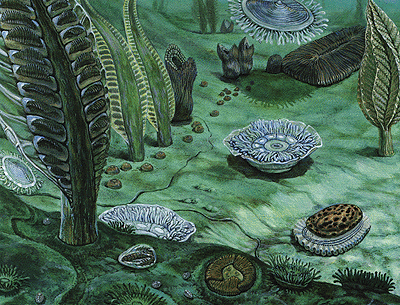
(The diverse range of life during the Cambrian 541-485 million years ago)

You may be forgiven for believing that dinosaurs were the earliest animals to appear. After all, when was the last time you heard such famous names as Dimetrodon (Cope, 1878), Ichthyostega (Save-Soderbergh, 1932) or Vinlandostrophia (Zuykov and Harper, 2007), all of which predate dinosaurs by a considerable amount of time. In this article, we will look at the major steps life took to get from the earliest, simplest forms of life to becoming a dinosaur.

File:Stromatolites in Sharkbay.jpg
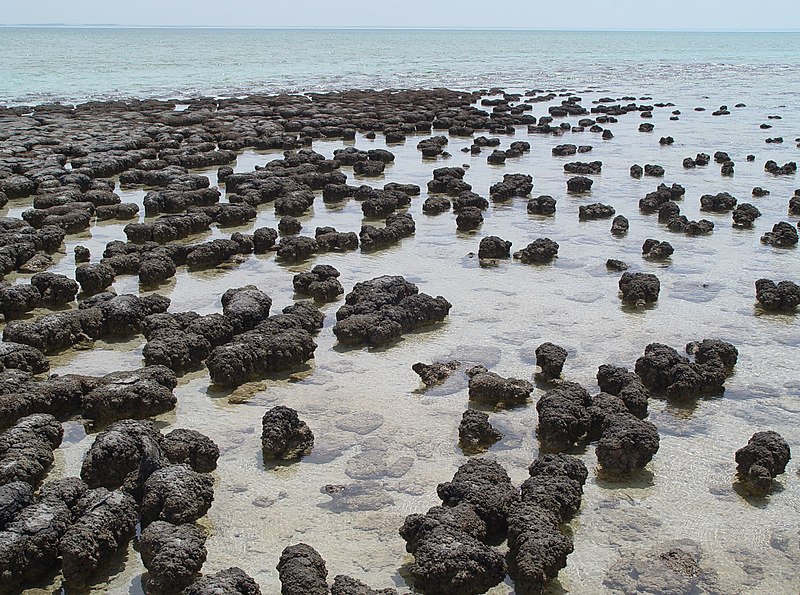
(Stromatolite colonies at Shark Bay, Australia)
The oldest fossils found have been dated to about 3.4 billion years ago, single-celled organisms that used sulphur rather than oxygen (Wacey et al., 2011) (we'll be looking at the origin of life and the origin of Earth another day). Such organisms are still around today. They are called cyanobacteria and are found in anaerobic (oxygen-less) environments, the most famous examples being stromatolites.

(Life in the Pre-Cambrian)

Towards the end of the Pre-Cambrian, about 635-542 million years ago, the first true multicellular lifeforms appeared. They are called the Ediacara biota, after the Ediacara Hills, Australia where many fossils have been found (Termier and Termier, 1960). Most of them just look like blobs of jelly, and indeed, many of them are still not universally accepted as being fossils. Along with this, their identity and where they fit into the tree of life, has remained a topic of much debate. Ideas have included: cnidarians (jellyfish, sea anemones, corals etc.) (Donovan and Lewis, 2001), the universal ancestors of all the animals (Glaessner, 1984), completely different forms of life that no longer exist (Seilacher, 1984), lichens (Retallack, 1994), algae (Ford, 1958), amoebae (Zhuravlev, 1992), fungi (Peterson et al., 2003) or bacterial colonies (Grazhdankin, 2001). Whatever they were, we'll be looking at them in more detail at a later date.

File:Jelly cc11.jpg
(Jellyfish Chrysaora fuscescens (Brandt, 1835))

At the start of the Cambrian, around 542 million years ago, something strange happened. The previous Ediacaran fauna, consisting of blob-things, largely disappeared (some persisting as late as the Mid Cambrian (Conway Morris, 1993)) and were replaced by organisms with hard parts (such as bone, teeth, shells etc.) and that resembled modern organisms such as jellyfish, molluscs and even vertebrates. This has been termed the "Cambrian Explosion of Life". But what happened? Where did these gribblies come from? And where did the Ediacaran "animals" go? These questions will be investigated some other day.

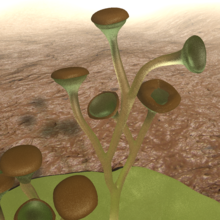
(Cooksonia (Lang, 1937), an early land plant)

The next major step for life was the colonisation of land. The earliest evidence for terrestrial life is found in rocks about 490 million years old. These fossils are of footprints believed to have been left by a strange group of amphibious arthropods called euthycarcinoids, which are regarded as being closely related to the myriapods (centipedes, millipedes and some other groups of long, multi-legged arthropods) (MacNaughton et al., 2002). Plants first appeared on land during the Mid Ordovician, around 476 million years ago. The evidence for this is based on spores of land plants similar to liverworts. The earliest definite land plant fossils are from 430 million-year-old rocks and belonged to a group called the club-mosses (Kenrick and Crane, 1997).

This horrifying Palaeozoic fish had a buzz saw for a face
(Helicoprion, (Karpinsky, 1899), an early shark-like fish)

The ancestors of the fish probably appeared about 530 million years ago and resembled short, fat eels (Shu et al., 1999). These first fish were jawless like today's lampreys and hagfish. Later, around 500-430 million years ago, large armoured jawless fish, called ostracoderms, appeared. Not long after, 420 million years ago, the first jawed fish appeared. The jawed fish proved to be very successful and the jawless fish declined, mostly going extinct at the end of the Devonian, 358 million years ago. The first jawed fish to appear, the Placoderms, were heavily armoured. They also went extinct at the end of the Devonian. Another early group were the Acanthodians or "spiny sharks" (they weren't sharks). The Acanthodians went extinct at the end of the Permian, 250 million years ago. The cartilaginous fish first appeared in the Middle Devonian, 395 million years ago. Today, three groups still exist: the chimaerae (also called elephantfish, ghostfish and rabbitfish), the sharks and the rays. The next major group of fish to appear, the bony fish or Osteichthyes appeared about 416 million years ago. They are made up of two groups: the Actinopterygii (the ray-finned fish) and the Sarcopterygii (the fleshy-finned fish). The former contains the vast majority of living fish. The latter includes the coelacanths, lungfish and the ancestors of the Tetrapods (amphibians, reptiles, birds and mammals).

(Acanthostega (Jarvik, 1952), an early tetrapodomorph)

The tetrapods first appeared about 395 million years ago, evolving from the sarcopterygian fish (although precisely which group is unclear at this time). Many tetrapods have been discovered, some resembling fish, some resembling amphibians and reptiles and others somewhere in between (dubbed "fishapods" by some). The exact placement of many of these taxa is unknown. But they are important because they were the forerunners of all amphibians, reptiles, birds and mammals that have ever existed.

(Euparkeria (Broom, 1913), an archosaur)

From those early tetrapodomorphs emerged all the amphibians, reptiles, birds and mammals. Other than when they first appeared, the amphibians have never really been the dominant animals on land. One of these early amphibian groups (and it's not clear which) gave rise to the amniotes. The amniotes are the reptiles, birds and mammals. They have been more successful than amphibians because they can lay their eggs in dry environments. Reptiles first appeared around 313 million years ago (Benton and Donoghue, 2007). Initially, it was the reptiles that gave rise to the mammals, the Synapsids, that ruled. This lasted until the Permian mass extinction, the largest mass extinction ever, wiped out nearly 90% of all life on Earth (Benton, 2005). After this extinction, the Diapsid reptiles (lizards, snakes, dinosaurs, crocodiles, pterosaurs, marine reptiles and possible tortoises) became more abundant. One of these groups, the Archosaurs, became the dominant terrestrial life forms from the Mid Triassic (Benton, 1983). From this group emerged the crocodiles, pterosaurs (maybe), birds and the dinosaurs.

And that brings us up to speed. As you can see, a lot happened before the Dinosaurs appeared. The next time-based post will be about the Mesozoic, the era in which the dinosaurs lived. However, the next post will be the second part of the Jurassic Park series, examining the issues surrounding the raptors.

See also:
More dinosaurs
Geochronology
Age of the Dinosaurs

References
Benton, M. (1983) 'Dinosaur Success in the Triassic: a Noncompetitive Ecological Model', Quarterly Review of Biology, 58 (1), pp. 29-55

Benton, M. (2005) When Life Nearly Died: The Greatest Mass Extinction of All Time, London: Thames & Hudson

Benton, M. and Donoghue, P. (2007) 'Paleontological Evidence to Date the Tree of Life', Molecular Biology and Evolution, 24 (1), pp. 26-53

Brandt, J. (1835) Prodromus Descriptionis: Animalium Ab H. Mertensio In Orbis Terrarum Circumnavigatone Observatorum, Petropoli

Broom, R. (1913) 'Note on Mesosuchus browni, Watson and on a new South African Triassic pseudosuchian (Euparkeria capensis)', Records of the Albany Museum, 2, pp. 394-396

Conway Morris, S. (1993) 'Ediacaran-like fossils in Cambrian Burgess Shale-type faunas of North America', Paleontology, 36 (31-0239), pp. 593-635

Cope, E. (1878) 'Descriptions of Extinct Batrachia and Reptilia from the Permian Formation of Texas', Proceedings of the American Philosophical Society, 17 (101), pp. 505-530

Donovan, S. and Lewis, D. (2001) 'Fossils explained 35. The Ediacaran biota', Geology Today, 17 (3), pp. 115-120

Ford, T. (1958) 'Pre-Cambrian fossils from Charnwood Forest', Proceedings of the Yorkshire Geological Society, 31 (6), pp. 211-217

Grazhdankin, D. (2001) 'Microbial Origin of some of the Ediacaran fossils', GSA Annual Meeting, 5-8 November, 2001, p. 177

Glaessner, M. (1984) The Dawn of Animal Life: A Biohistorical Study, Cambridge: Cambridge University Press

Jarvik, E. (1952) 'On the fish-like tail in the ichthyostegid stegocephalians with descriptions of a new stegocephalian and a new crossopterygian from the Upper Devonian of Greenland', Meddelelser on Gronland, 114 (12), pp. 1-90

Karpinsky, A. (1899) Ueber die reste und die neue gattung Helicoprion, St. Petersburg: K. Russiche mineralogische gesellschaft zu St. Petersburg

Kenrick, P. and Crane, P. (1997) 'The origin and early evolution of plants on land', Nature, 389 (6646), p. 33

Lang, W. (1937) 'On the Plant remains from the Downtonian of England and Wales', Philosophical Transactions of the Royal Society B, 227 (544), pp. 245-291

MacNaughton, R., Cole, J., Dalrymple, R., Braddy, S., Briggs, D. and Lukie, T. (2002) 'First steps on land: Arthropod trackways in Cambrian-Ordovician eolian sandstone, southeastern Ontario, Canada', Geology, 30 (5), pp. 391-394

Peterson, K., Waggoner, B. and Hagadorn, J. (2003) 'A Fungal Analog for Newfoundland Ediacaran Fossils?', Integrative and Comparative Biology, 43 (1), pp. 127-136

Retallack, G. (1994) 'Were the Ediacaran fossils lichens?', Paleobiology, 20 (4), pp. 523-544

Save-Soderbergh, G. (1932) 'Preliminary note on Devonian stegocephalians from East Greenland', Meddelelser on Gronland, 98 (3), pp. 1-211

Seilacher, A. (1984) 'Late Precambrian and Early Cambrian Metazoa: preservational or real extinctions?', in Holland, H. and Trendell, A., Patterns of Change in Earth Evolution, Heidelberg: Springer-Verlag, pp. 159-168

Shu, D-G., Luo, H-L., Conway Morris, S., Zhang, X-L., Hu, S-X., Chen, L., Han, J., Zhu, M., Li, Y. and Chen, L-Z. (1999) 'Lower Cambrian vertebrates from south China', Nature, 402 (6757), pp. 42-46

Termier, H. and Termier, G. (1960) 'L'Ediacarien, premier etage paleontologique' [The Ediacaran, first paleontological stage], Revue Génerale des Sciences pures et Appliquées et Bulletin de l'Association Francaise pour l'Avancement des Sciences, 67 (3-4), pp. 175-192

Wacey, D., Kilburn, M., Saunders, M. Cliff, J. and Brasier, M. (2011) 'Microfossils of sulphur-metabolizing cells in 3.4-billion-year-old rocks of Western Australia', Nature Geoscience, 4, pp. 698-702

Zhuravlev, A. (1992) 'Were Ediacaran Vendobionta multicellulars?', Neues Jahrbuch für Geologie und Paläontologie, Abhandlungen, 190 (2-3), pp. 299-314

Zuykov, M. and Harper, D. (2007) 'Platystrophia (Orthida) and new related Ordovician and Early Silurian brachiopod genera', Estonian Journal of Earth Sciences, 56 (1), pp. 11-34

Sunday, 23 June 2013

Tyrannosaurus rex Part 2 - Systematics


Last time, we looked at the anatomy of Tyrannosaurus rex. This week, we will look at where it fits in relation to other dinosaurs.

The following cladograms (adapted from Tweet, 2013) illustrate Tyrannosaurus rex's position. The groups to which Tyrannosaurus rex belongs will be placed at the bottom.

Cladogram of Dinosauria (Owen, 1842)

O - Dinosauria
 |---o Ornithischia (Seeley, 1888)
 `---o Saurischia (Seeley, 1888)

The Ornithischia contains the horned dinosaurs, the armoured dinosaurs and the duck-billed dinosaurs. The Saurischia contains the meat-eating and the long-necked dinosaurs.

O - Saurischia
 |--- o Herrerasauridae (Reig, 1963)
 |--- o Sauropodomorpha (Huene, 1932)
 `---o Theropoda (Marsh, 1881)

The Herrerasauridae contain a small group of dinosaurs that have bounced between the Sauropodomorpha and the Theropoda since...well, forever really (and have sometimes believed to be non-dinosaurs). The Sauropodomorpha contains the Sauropods and their relatives. Theropoda contains all the meat-eating dinosaurs.

O - Theropoda
 |---o Daemonosaurus (Sues et al., 2011)
 `---+---o Tawa (Nesbitt et al., 2009)
        `---o Neotheropoda (Bakker, 1986)

Daemonosaurus and Tawa are the most basal ("primitive") well-established Theropods (if you discount the Herrerasaurids that is). The Neotheropoda contains all the other Theropods, being characterised by only four fingers (as opposed to five), a small fourth finger (and in some, no fourth finger at all), and three weight-bearing toes (sometimes with a fourth toe higher up that is not in contact with the ground).

O - Neotheropoda
 | ---o Coelophysoidea (Holtz, 1994)
 `---+---o Zupaysaurus (Arcucci and Coria, 2003)
        `---+---o Dilophosauridae (Madsen and Welles, 2000)
               `---o Averostra (Paul, 2002)

The Coelophysoids were basal theropods that were typically small with long, low bodies, long necks and heads and short hands. Zupaysaurus is somewhere in between the Coelophysoids and the Dilophosaurids. The Dilophosaurids were effectively larger versions of Coelophysoids with shorter necks and they had a sort of kink in their jaws like crocodiles do. The Averostra consists of all other theropods which, unlike the Coelophysoids and the Dilophosaurids have an extra hole in their upper jaw called the promaxillary fenestra.

O - Averostra
 |---o Ceratosauria (Marsh, 1884)
 `---o Tetanurae (Gauthier, 1986)

The Ceratosaurians are an arbitrary group of Averostrans that aren't Tetanurans but no-one can agree on their characteristics or members. The Tetanurae consists of theropods that lack a fourth digit on their hand, have all their upper jaw teeth situated in front of the eyes and have a strap-like shoulder-blade.

O - Tetanurae
 |---o Chuandongocoelurus (He, 1984)
 |---o Monolophosaurus (Zhao and Currie, 1993)
 `---+---o Megalosauroidea (Huxley, 1869)
        `---o Avetheropoda (Paul, 1988)

The Megalosauroids have long, low builds and short, stout arms (being used as fishing implements by some). The Avetheropods, as their name would suggest, contain the bird-like theropods.

O - Avetheropoda
|---o Carnosauria (Huene, 1920)
`---o Coelurosauria (Huene, 1914)

Traditionally, the big theropods were in the Carnosauria and the small theropods in Coelurosauria. This has now been abandoned. In general the Carnosaurs had large eyes, long, narrow skulls and thighs longer than their shins. The Coelurosaurs have a long sacrum, a stiffened tail (especially at the tip), a bowed ulna (one the forearm bones) and shins longer than their thighs.

O - Coelurosauria
|---o Compsognathidae (Cope, 1871)
`---+---o "Bunch of well-known coelurosaurs that don't fit anywhere"
      `---o Tyrannoraptora (Sereno, 1999)

The Compsognathids were tiny coelurosaurs. The Tyrannoraptora are all the coelurosaurs closer to birds than the Compsognathids. In between, are a large number of dinosaurs that don't fit anywhere else. In fact, some have suggested that the classification of basal coelurosaurs needs to be completely re-written given the number of taxa that don't have a home and the fact that neither the Compsognathids nor the Tyrannoraptorans have an agreed-upon set of characteristics.

O Tyrannoraptora
 |---+---o Coelurus (Marsh, 1879)
 |     `---o Maniraptoriformes (Holtz, 1995)
 `---o Tyrannosauroidea (Walker, 1964)

Coelurus is another critter that changes address every few years. Maniraptoriformes contains all the theropods closer to birds than to Tyrannosaurus. They are generally characterised by having bird-like shoulders and breastbones. The Tyrannosauroids are what we are interested in.

O Tyrannosauroidea
|--? Bagaraatan (Osmolska, 1996)
`---+---o Proceratosauridae (Rauhut et al., 2010)
      |---o Dilong (Xu et al., 2004)
      `---+---o Yutyrannus (Xu et al., 2012)
            `---+---+---o Eotyrannus (Hutt et al., 2001)
                   |      |---o Juratyrant (Brusatte and Benson, 2012)
                   |      `---o Stokesosaurus (Madsen, 1974)
                   |---o Xiongguanlong (Li et al., 2010)
                   `---+---o Dryptosaurus (Marsh, 1877)
                         `---+---o Appalachiosaurus (Carr et al., 2005)
                                `---+---o Bistahieversor (Carr and Williamson, 2010)
                                       `---o Tyrannosauridae (Osborn, 1905)

Bagaraatan might actually be a basal coelurosaurian instead (Unfortunately, because Tyrannosauroids branched off from the family tree so early on, basal coelurosaurians and basal tyrannosauroids are very similar). The Proceratosaurids had crests. The dinosaurs between the Proceratosaurids and the Tyrannosaurids, possessed three fingers on their hands and were relatively small (with the notable exception of Yutyrannus being 9m long). Quite a few of them also had feather-like coatings. The Tyrannosaurids were big and bad with the teeth at the front of the jaws D-shaped in cross-section and two fingers on their hands.

O Tyrannosauridae
 |---o Albertosaurinae (Currie et al., 2003)
 `---o Tyrannosaurinae (Matthew and Brown, 1922)

The Albertosaurines were generally smaller and possessed small horns in front of their eyes. The Tyrannosaurines were generally larger and possessed large bumps (called bosses) behind their eyes. The next tree is the last one, I promise.

O Tyrannosaurinae
|---o Alioramus (Kurzanov, 1976)
`---+---o Teratophoneus (Carr et al., 2011)
       `---+---o Daspletosaurus (Russell, 1970)
             `---+---o Tarbosaurus (Maleev, 1955)
                    `---o Tyrannosaurus (Osborn, 1905)

There are two types of Tyrannosaur researcher: the lumpers and the splitters. The lumpers regard all of these taxa to be synonymous with Tyrannosaurus whereas the splitters split them into into multiple genera and species (some of which we will look at in Part 3). I was hoping to cover them in this post, but considering this took me two weeks to do, I decided to leave it here. Next time, we'll look at life before the dinosaurs.

See also:
More dinosaurs
More Tyrannosaurus rex

References:
Arcucci, A. and Coria, R., (2003) 'A new Triassic carnivorous dinosaur from Argentina', Ameghiniana, 40 (2), pp. 217-228

Bakker, R. (1986) The Dinosaur Heresies, New York: William Morrow

Brusatte, S. and Benson, R. (2012) 'The systematics of Late Jurassic tyrannosauroids (Dinosauria: Theropoda) from Europe and North America', Acta Palaeontologica Polonica, 58 (1), pp. 47-54

Carr, T., Williamson, T. and Schwimmer, D. (2005) 'A new genus and species of tyrannosauroid from the Late Cretaceous (middle Campanian) Demopolis Formation of Alabama', Journal of Vertebrate Paleontology, 25 (1), pp. 119-143

Carr, T. and Williamson, T. (2010) 'Bistahieversor sealeyi, gen. et sp. nov., a new tyrannosauroid from New Mexico and the origin of deep snouts in Tyrannosauroidea', Journal of Vertebrate Paleontology, 30 (1), pp. 1-16

Carr, T., Williamson, T., Britt, B. and Stadtman, K. (2011) 'Evidence for high taxonomic and morphologic tyrannosauroid diversity in the Late Cretaceous (Late Campanian) of the American Southwest and a new short-skulled tyrannosaurid from the Kaiparowits Formation of Utah', Naturwissenschaften, 98 (3), pp. 241-246

Cope, E. (1871) 'Supplement to the synopsis of the extinct Batrachia and Reptilia of North America', Proceedings of the American Philosophical Society, 12 (86), pp. 41-52

Currie, P., Hurum, H. and Sabath, K. (2003) 'Skull structure and evolution in tyrannosaurid dinosaurs', Acta Palaeontologica Polonica, 48 (2), pp. 227-234

Gauthier, J. (1986) 'Saurischian monophyly and the origin of birds', in Padian, K. (ed) 'The Origin of Birds and the Evolution of Flight', Memoirs of the California Academy of Science, 8, pp. 1-55

He, X. (1984) [The Vertebrate Fossils of Sichuan], Chengdu: Sichuan Scientific and Technical Publishing House

Holtz, T. (1994) 'The phylogenetic position of the Tyrannosauridae: Implications for theropod systematics', Journal of Paleontology, 68 (5), pp. 1100-1117

Holtz, T. and Padian, K. (1995) 'Definition and diagnosis of Theropoda and related taxa', Journal of Vertebrate Paleontology, 15 (supplement), p. 35A

Huene, F. von (1914) 'Das naturliche System der Saurischia' [The natural System of Saurischia], Zentralblatt fur Mineralogie, Geologie und Palaeontologie B, 1914, pp. 154-158

Huene, F. von (1920) 'Bemerkungen zur Systematik und Stammesgeschichte einiger Reptilien' [Notes on the Systematics and Phylogeny of some Reptiles], Zeitschrift fur Induktive Abstammungs-und Vererbungslehre, 22 (3), pp. 209-212

Huene, F. von (1932) 'Die fossile Reptil-Ordnung Saurischia, ihre Entwicklung und Geschichte', [The fossil reptile order Saurischia, their development and history], Monographien zur Geologie und Palaeontologie, 1 (4), pp. 1-361

Hutt, S., Naish, D., Martill, D., Barker, M. and Newbery, P. (2001) 'A preliminary account of a new tyrannosauroid theropod from the Wessex Formation (Early Cretaceous) of southern England' Cretaceous Research, 22 (2), pp. 227-242

Huxley, T. (1869) 'On the upper jaw of Megalosaurus', Quarterly Journal of the Geological Society of London, 25 (1), pp. 311-314

Kurzanov, S. (1976) '[A new Late Cretaceous carnosaur from Nogon-Tsav, Mongolia], in Kramarenko, N., Luvsandansan, B., Voronin, Y., Barsbold, R., Rozhdestvensky, A., Trofimov, B. and Reshitov, V. (Eds) 'Palaeontology and Biostratigraphy of Mongolia', The Joint Soviet-Mongolian Palaeontological Expedition, Transactions, 3, pp. 93-104

Li, D., Norell, M., Gao, K-Q., Smith, N. and Makovicky, P. (2010) 'A longirostrine tyrannosauroid from the Early Cretaceous of China', Proceedings of the Royal Society B, 277 (1679), pp. 183-190

Madsen, J. (1974) 'A new theropod dinosaur from the Upper Jurassic of Utah', Journal of Paleontology, 48 (1), pp. 27-31

Madsen, J. and Welles, S. (2000) Ceratosaurus (Dinosauria, Theropoda) a revised osteology, Salt Lake City: Utah Geological Survey

Maleev, E. (1955) '[New carnivorous dinosaurs from the Upper Cretaceous of Mongolia], Doklady Akademii Nauk SSSR, 104 (5), pp. 779-783

Marsh, O. (1877) 'Notice of some new dinosaurian reptiles from the Jurassic Formation', American Journal of Science, 3 (14), pp. 514-516

Marsh, O. (1878) 'Notice of new Jurassic reptiles', American Journal of Science, 3 (18), pp. 501-505

Marsh, O. (1881) 'Principle characters of American Jurassic dinosaurs. Part V.', American Journal of Science, 3 (21), pp. 417-423

Marsh, O. (1884) 'Principle characters of American Jurassic dinosaurs. Part VIII. The Order Theropoda', American Journal of Science, 3 (27), pp. 329-340

Matthew, W. and Brown, B. (1922) 'The family Deinodontidae, with notice of a new genus from the Cretaceous of Alberta', Bulletin of the American Museum of Natural History, 46, pp. 367-385

Nesbitt, S., Smith, N., Irmis, R., Turner, R., Downs, A. and Norell, M. (2009) 'A complete skeleton of a Late Triassic saurischian and the early evolution of dinosaurs', Science, 326 (5959), pp. 1530-1533

Osborn, H. (1905) 'Tyrannosaurus and other Cretaceous carnivorous dinosaurs', Bulletin of the American Museum of Natural History, 21, pp. 259-265

Osmolska, H. (1996) 'An unusual theropod dinosaur from the Late Cretaceous Nemegt Formation of Mongolia', Acta Palaeontologica Polonica, 41 (1), pp. 1-38

Owen, R. (1842) 'Report on British fossil reptiles. Part II', in, British Association for the Advancement of Science, Report of the Eleventh Meeting of the British Association for the Advancement of Science, London: John Murray, pp. 60-204

Paul, G. (1988) Predatory Dinosaurs of the World: A Complete Illustrated Guide, New York: Simon and Schuster

Paul, G. (2002) Dinosaurs of the Air, Baltimore: The Johns Hopkins University Press

Rauhut, O., Milner, A. and Moore-Fay, S. (2010) 'Cranial osteology and phylogenetic position of the theropod dinosaur Proceratosaurus bradleyi (Woodward, 1910) from the Middle Jurassic of England', Zoological Journal of the Linnean Society, 158 (1), pp. 155-195

Reig, O. (1963) 'La prescencia de dinosaurios saurisquios en los "Estrados de Ischigualasto" (Mesotriásico superior) de las Provincias de San Juan y La Rioja (Republica Argentina)' [The presence of saurischian dinosaurs in the "Ischigualasto formation" (Late Middle Triassic) in the provinces of San Juan and La Rioja (Republic of Argentina)], Ameghiniana, 3 (1), pp. 3-20

Russell, D. (1970) 'Tyrannosaurs from the Late Cretaceous of western Canada', National Museum of Natural Sciences Publications in Paleontology, 1 (1), pp. 1-34

Seeley, H. (1888) 'The classification of the Dinosauria', Proceedings of the Royal Society of London, 43 (258-265), pp. 165-171

Sereno, P. (1999) 'The evolution of Dinosaurs', Science, 284 (5423), pp. 2137-2147

Sues, H-D., Nesbitt, S., Berman, D. and Henrici, A., (2011) 'A late-surviving basal theropod dinosaur from the Latest Triassic of North America', Proceedings of the Royal Society B, 278 (1723), pp. 3459-3464

Tweet, J. Thescelosaurus, [Online] Available at: http://www.thescelosaurus.com/index.html, Accessed on: 13/06/2013

Walker, A. (1964) 'Triassic reptiles from the Elgin area: Ornithosuchus and the origin of carnosaurs', Philosophical Transactions of the Royal Society B, 248 (744), pp. 53-134

Xu, X., Norell, M., Kuang, X., Wang, X., Zhao, Q. and Jia, C. (2004) 'Basal tyrannosauroids from China and evidence for protofeathers in tyrannosauroids', Nature, 431 (7009), pp. 680-684

Xu, X., Wang, K., Zhang, K., Ma, Q., Xing, L., Sullivan, C., Hu, D., Cheng, S. and Wang, S. (2012) 'A gigantic feathered dinosaur from the Lower Cretaceous of China, Nature, 484 (7392), pp. 92-95

Zhao, X-J. and Currie, P. (1993) 'A large crested theropod from the Jurassic of Xinjiang, People's Republic of China', in Currie, P. (ed) 'Results from the Sino-Canadian Dinosaur Project', Canadian Journal of Earth Sciences, 30 (10), pp. 2027-2036

Thursday, 6 June 2013

The Code

This post is all about The Code. No, not the Pirate code from Pirates of the Caribbean but the code of the International Commission of Zoological Nomenclature (ICZN, 2012). This is the code that is used for determining whether a name is valid or not. It is not to be used to establish whether a particular species is unique or not. I'll try to keep it simple because like a lot of rulebooks, it can get complicated (especially when it comes to determining type specimens - more on that later).

Definition - The ICZN code is the system of scientific names to taxonomic units of extinct and extant (not extinct) animals. These units are called "taxon" when singular and "taxa" when plural. For the purposes of the Code, animal refers to members of the taxon Metazoa and any protistans regarded as animals by authors (protistans are microscopic organisms in-between algae and animals and no-one is too sure what they are)

Scope - Scientific names are those based on: actual specimens (either complete or intact), domesticated animals, names based on fossils, names based on fossilised work of animals (such as footprints, eggs, burrows etc., these are called ichnotaxa), names for groups of animals and, for those named before 1930, the work of extant animals. Additionally, the Code only really applies to names at the family, genus and species levels. Above the rank of family is not so rigorously enforced (these names are usually subject to general consensus)

Exclusions - The following are excluded from the code and hence are not regarded as valid names:

  • Hypothetical concepts
  • Teratological specimens (deformities, mutants, etc.)
  • Hybrids
  • Infrasubspecific entities (such as breeds of dogs)
  • Temporary or provisional names
  • After 1930, the work of extant animals
  • Modifications of available names with a common suffix or prefix to indicate the group it belongs to (e.g. Herrera (1899, cited in ICZN, 2012) proposed that every genus should have a three-letter prefix to indicate class such as all insects having Ins- or all mammals having Mam- at the beginning of the name)

Independence - The code is independent of other systems. There is a separate code for plants and fungi and a separate one for Bacteria. And whilst it is acceptable for an animal to have the same name as a plant, it is not recommended.

Any name that has been regarded as an animal at any point is deemed unavailable for future use. For example, if I were to describe what I believed to be a dinosaur as Alphasaurus and it was later found to be a plant (this has actually happened) the name Alphasaurus would still be unavailable for another animal, despite the fact that it is now a plant.

Any name published after 1 January 1758 is accepted.

No name or taxonomic change made before 1758 is acceptable but information (such as descriptions and pictures) can be used

Names higher in rank than species must consist of a single word and it must be capitalised (Such as the genus for man Homo or the cow family Bovidae)

Species must consist of two names - the generic name and specific name (known as an epithet). The generic name is capitalised, the epithet is not (Such as man Homo sapiens)

Subspecies must consist of three names - again the genus is capitalised and the specific and subspecific names are not (Such as modern man Homo sapiens sapiens)

Typographical symbols such as ., ,, ? and -, do not form part of the name.

In order for a publication (and thus any new names and changes made therein) to be regarded as valid, it must adhere to the following criteria:

  • it must be issued for the purpose of providing a public and permanent scientific record
  • it must be obtainable, when first issued, free of charge or by purchase
  • it must have been produced in an edition containing simultaneously obtainable copies by a method that assures numerous identical and durable copies and widely accessible electronic copies with fixed content and layout
The copies must be in the form of either a paper copy or, between 1986-2012, on an optical disc.

For publications that are entirely online/electronic, they will considered acceptable if:
  • They were issued after 2011
  • State the date the publication was published
  • Are registered with ZooBank (an online repository of taxonomic changes)
The following are not considered valid publications:
  • Handwritten papers (after 1930)
  • Works produced by hectographing or mimeographing (1986-2012) (whatever the hell they are)
  • Photographs on their own
  • Proof sheets
  • Microfilms
  • Acoustic records of any kind
  • Labels of specimens
  • Preliminary versions of the work (a lot of online publications are put up before being officially published)
  • Materials issued to participants at a meeting, convention, symposium etc.
  • Text and illustrations distributed on the internet (unless they meet the conditions of the previous rule)
  • Copies of works that have not been published (this includes PhD theses and dissertations)
As well as rules for the publication itself, there are rules for the names. For a name to be valid it must be written in the Latin alphabet (a-z). It must derive from a pre-existing language (arbitrary combinations of letters are acceptable, but only if they form a pronounceable word). For names before 1931, they must be accompanied by a description or at least a reference to one. For names between 1931-1999, they must also be accompanied with a diagnosis in order to differentiate it from other taxa. Anonymous works are valid if they were published before 1951. After 1999, all new names must be explicitly stated as such (usually by adding sp. nov. or gen. nov. or fam. nov. afterwards, nov. being short for nova, Latin for new). Family names must be listed with a type genus that best represents the group (for example the great ape family Hominidae is named after Homo, Tyrannosauridae is named after Tyrannosaurus etc.).

Names can be changed under certain circumstances such as if the gender is wrong or if the name is constantly spelled differently in the original publication (in this case, the first spelling used takes precedence, even if it was not the intended one).

When using a name, the author and date of publication should be used. Normally, if the author and date is shown in brackets, it means the taxon was placed in a different genus originally (for example, if I was to describe a new dinosaur as Betasaurus basingstokensis, it would be written as: Betasaurus basingstokensis Lucas, 2013. But if it is later re-classified it would be written as: Deltasaurus basingstokensis (Lucas, 2013)).

The most important part of the Code is the Principle of Priority. This states that the oldest valid name is to be used. For example, if Gammasaurus Lucas, 2011 and Epsilonsaurus, Lucas, 2013, were found to be the same, Gammasaurus would be the correct name to be used because it is older. This also applies to identical names (called homonyms). For example, if there was a Zetasaurus, Smith, 1930 and then decades later a Zetasaurus, Lucas, 2013, Lucas' Zetasaurus would have to be re-named because it is younger. This applies even if the older name is no longer valid. For example, even though Brontosaurus is no longer a valid taxon, the name can never be used again. If two names were published at the same time and found to be synonymous, the author who discovered this can choose which name to use (this is known as the First Reviser Rule). For example, Tyrannosaurus and Dynamosaurus were both named by Osborn in 1905. The following year, he announced they were the same, and since they were named at the same time, Osborn chose Tyrannosaurus to be the correct name (he could have quite easily chosen Dynamosaurus and that would have been the most famous dinosaur name instead). 

The first time a taxon is mentioned in a paper, it must be written out in full. It can then be abbreviated afterwards. For example, if I was to write an article describing Etasaurus cornwallensis I would write it out in full, but after that, I can refer to it as E. cornwallensis (although, I don't personally like abbreviating taxa). No diacritics, marks, punctuation or symbols may be used. Hyphens can be used in some circumstances. For example, if I wanted to name a species of Thetasaurus after St. Austell, I would not be able to use the "." after St in the name. So it would become Thetasaurus staustellensis

Family group names have specific suffixes depending on their rank. -oidea for superfamilies, -idae for families, -inae for subfamilies, -ini for tribes and -ina for subtribes. Generic and species names must have the same gender endings (generally -us is masculine, -a is feminine and -um is neutral, though there are exceptions). For example Iotasaurus is masculine and needs a masculine species name, Kappasaura is feminine and needs a feminine species name and Lambdasaurum is neutral and so needs a neutral species name. Species names can be modified is the new generic name has a different gender. For example, if Musaurus cristatus (a masculine name) is reclassified into Nusaura, cristatus would have to change to cristata. The original spellings must be used, even if they are technically incorrect. For example, if Xisaurus senai was named after John Cena, the original senai spelling must be used. The only exceptions to this is if the original name is invalid because it contains accents, punctuation marks, numerals etc. 

That's about it. Not much more to say. Sorry it's a bit wordy but it's an important aspect of science and it's best to get it over now then keep referring to it in posts. My next non-dinosaur post will be about Butterflies. Next week will see the much-anticipated part 2 of Tyrannosaurus rex.

See also:
More dinosaurs

References:
ICZN (2012) 'International Code of Zoological Nomenclature', [Online], Available at: http://www.nhm.ac.uk/hosted-sites/iczn/code/, Accessed on: 06/06/2013

Sunday, 2 June 2013

Frequently Asked Dinosaur Question 1: Which was the biggest dinosaur?


This is probably THE most asked question, especially by children. Humans seem to have a fascination with size, always striving to find the biggest of something, and dinosaurs are no exception. As a result, many sources (some more accurate than others) have catered to this compulsion. In this post, we'll take a look at the most frequently cited candidates, and examine their credentials in more detail. (And for the purposes of this article, I'm using biggest to mean tallest/longest not heaviest - simply because weight is nearly impossible to guess for fossils)

Candidate Number 1: Seismosaurus
Seismosaurus (the Earth-Shaking Lizard) was a sauropod (as are all the contenders for largest dinosaur ever). In the early 1990s there was a dinosaur magazine series (called DINOSAURS!) that had an FAQ on the back cover of each issue. These involved asking Dr. David Norman (who is probably the country's leading expert on dinosaurs, specialising in iguanodonts) a series of questions. When asked what the biggest dinosaur was, he said Seismosaurus (Orbis, 1992) giving a length of 36.5m. Seismosaurus hallorum (Hall's Earth-Shaking Lizard - originally called halli but had to change due to grammar rules (Olshevsky, 1998)) was described by David Gillette in 1991 and was first estimated to be 39-51m (Gillette, 1991). However, we can discount Seismosaurus (sort of) because in 2006 it was found to be the same as Diplodocus (Carpenter, 2006). There is currently disagreement as to whether it is a valid species of Diplodocus (as Diplodocus hallorum) or whether it should be further synonymised with another species, Diplodocus longus (Marsh, 1878).

Candidate Number 2: Giraffatitan
Oh this one. You probably already know about this dinosaur because for most of the 20th century it was regarded as being a species of Brachiosaurus (Arm Lizard) (Riggs, 1903) (Brachiosaurus brancai (Branca's Arm Lizard), Janensch, 1914) (and indeed pretty much everything written about Brachiosaurus was based on this one rather than the original species). As a result, what you know of as Brachiosaurus is actually Giraffatitan (Titan Giraffe) (Paul, 1988), although this didn't become widely accepted until around 2003/4. Anyway, this dinosaur is known from the largest complete skeleton of a dinosaur ever discovered, found in Tanzania, East Africa between 1909-1912. The skeleton is now housed in the Berlin Museum of Natural History. It is 21.8 m long (Mazzetta, et al., 2004). However, despite its great size, this specimen is believed to only be a subadult and a larger, more mature specimen has been found (Taylor, 2009) which measures approximately 26 m (Holtz, 2008).

Candidate Number 3: Diplodocus
Continuing on from Seismosaurus above, it has now been shown that not only is Seismosaurus the same as Diplodocus (Double Beam), but also that Gillette overestimated the size. The current size estimate for Diplodocus (Marsh, 1878) is 33 m (Lucas, et al., 2004). Not much more to say really.

Candidate Number 4: Argentinosaurus
OK, now we get to sauropods that we are less certain of in terms of size. Argentinosaurus huinculensis (Argentine Lizard from Huincul) (Bonaparte and Coria, 1993) is known only from vertebrae, a few ribs and a tibia (shin bone). Size estimates have included: 30-35 m (Paul, 1994), 30 m (Carpenter, 2006) and 22-26 m (Mortimer, 2001).

Candidate Number 5: Supersaurus
Supersaurus vivianae (Vivian's Super Lizard) (Jensen, 1985) might sound like the sort of name a 5-year-old would come up with but it is a genuine dinosaur. It also includes another generic-sounding taxon named in the same paper, Ultrasauros mcintoshi (McIntosh's Ultra Lizard) (Jensen, 1985) (Originally called Ultrasaurus but this name had already been taken by a sauropod from South Korea (Kim, 1983) and so it was subsequently re-named Ultrasauros (Olshevsky, 1991)). Ultrasauros was found to be a chimaera (a taxon composed of more than one animal), in this case the vertebra belonged to Supersaurus and the scapula (shoulder blade) to Brachiosaurus (actual Brachiosaurus not Giraffatitan) (Curtice, et al., 1996). Anyway, Supersaurus has been estimated to attain a length of 33-34 m (Lovelace, et al., 2007).

Candidate Number 6: Sauroposeidon
Sauroposeidon proteles (Perfect Before the End Lizard Poseidon) (Because it was one of the last sauropods and Poseidon was the Greek God of Earthquakes, again likening its footsteps to an earthquake) (Wedel et al., 2000a) received a lot of media attention when announced back in 2000, with many outlets proclaiming it to be "THE BIGGEST DINOSAUR EVARZZZ!!!!!!111", which, while possible, is too premature given the current specimens known. It was certainly the tallest dinosaur, able to raise its head 17 m above the ground (Wedel et al., 2000b), but as for its length, estimates have ranged from 28-34 m (Wedel and Cifelli, 2005, Wedel et al., 2000b, Carpenter, 2006).

Candidate Number 7: Bruhathkayosaurus
Now we get into the "very-likely-to-be-hoaxes" category. Bruhathkayosaurus matleyi (Matley's Huge-Bodied Lizard) (Yadagiri and Ayyasami, 1989) was initially described as an Allosauroid theropod (somehow?!?!). But there are a number of problems with this one: 1) The description was brief and vague and I doubt the authors have a firm grasp of English 2) The drawings and photographs are...well see for yourself:
 
(why the text is upside-down I don't know)


3) The authors have only ever published one other paper on dinosaurs in which they named Dravidosaurus blanfordi (Blanford's Dravidanadu Lizard) (Yadagiri and Ayyasami, 1979), claiming it to be the smallest, youngest and only Gondwanan stegosaurian. That was until the 1990s when the poorly preserved remains were re-identified as being plesiosaurian (Chatterjee and Rudra, 1996). Therefore, their credentials and opinions shouldn't be taken at face value.

4) The guy who classified them as sauropod (and also re-identified Dravidosaurus as a plesiosaur), Sankar Chatterjee, has a...questionable reputation for getting things wrong (A good example is Protoavis texensis (First Bird from Texas) (Chatterjee, 1991) which he claimed was the oldest bird, being 75-60 million years older than Archaeopteryx (Ancient Wing) (Meyer, 1861) but is more likely to be some random reptile that vaguely looks like a bird)

5) And, to top it all off, the fossils were never fully dug out of the ground and were washed away in a monsoon. I am not kidding.

 As a result of this, I think we can ignore Bruhathkayosaurus. Oh, and no actual sizes were ever given.

Candidate number 8: Amphicoelias fragillimus
We finally get to the final candidate and my personal favourite for the title of "World's Largest Dinosaur". Amphicoelias fragillimus (Most Fragile Double Cavities) (Cope, 1878) is based on a partial vertebra discovered by Oramel Lucas in 1877  in Garden Park, Colorado. The vertebra was huge, 2.7 m high (Carpenter, 2006). The most recent size estimate (Carpenter, 2006) is 58 m long - TWICE as long as any of the other candidates here, and longer than even the Blue Whale. Unfortunately, like Bruhathkayosaurus, the fossil has seemingly disappeared, having simply disintegrated on the train as it was being transported (Hence the name fragillimus).

And that's it. These are the most common candidates for the largest dinosaur ever. The next FAQ will look at dinosaur age and growth. Next week will look at the first non-dinosaur post as we take a closer look at The Rules.

See also:
More dinosaurs
More about Edward Drinker Cope, the guy who named Amphicoelias fragillimus

References
Bonaparte, J. and Coria, S. (1993) 'Un nuevo y gigantesco sauropodo titanosaurio de la Formación Río Limay (Albaniano-Cenomanio) de la Provincia del Neuquén, Argentina', [A new gigantic sauropod titanosaur from the Río Limay Formation (Albanian-Cenomanian) of the Province of Neuquén, Argentina], Ameghiniana, 30 (3), pp. 271-282

Carpenter, K. (2006) 'Biggest of the big: a critical re-evaluation of the mega-sauropod Amphicoelias fragillimus' in Foster, J. and Lucas, S. (Eds) Paleontology and Geology of the Upper Jurassic Morrison Formation, Albuquerque: New Mexico Museum of Natural History and Science

Chatterjee, S. (1991) 'Cranial anatomy and relationships of a new Triassic bird from Texas', Philosophical Transactions of the Royal Society B: Biological Sciences, 332 (1265), pp. 277-342

Chatterjee, S. and Rudra, D. (1996) 'KT events in India: impact, rifting, volcanism and dinosaur extinctions', in Novas, F. and Molnar, R. (Eds) Proceedings of the Gondwanan Dinosaur Symposium, Brisbane, Memoirs of the Queensland Museum, 39 (3), pp. 489-532

Cope, E. (1878) 'A new species of Amphicoelias'', American Naturalist 12 (8), pp. 563-564

Curtice, B., Steadman, K. and Curtice, L. (1996) 'A reassessment of Ultrasaurus mcintoshi (Jensen, 1985)' in Morales, M. (Ed), The Continental Jurassic, Flagstaff: Museum of Northern Arizona

Gillette, D. (1991) 'Seismosaurus halli, gen. et sp. nov., a new sauropod dinosaur from the Morrison Formation (Upper Jurassic/Lower Cretaceous) of New Mexico, USA', Journal of Vertebrate Paleontology, 11 (4), pp. 417-433, doi: 10.1080/02724634.1991.10011413

Holtz, T. (2008) Dinosaurs: The Most Complete, Up-to-Date Encyclopedia for Dinosaur Lovers of All Ages, New York: Random House

Janensch, W. (1914) 'Ubersicht uber die Wirbeltierfauna der Tendaguru-Schichten, nebst einer kurzen Charakterisierung der neu aufgefuhrten Arten von Sauropoden' [Overview of the vertebrate fauna of the Tendaguru layers, along with a brief characterisation of the newly described species of sauropod], Arch. Biotol., 3, pp. 81-110

Jensen, J. (1985) 'Three new sauropod dinosaurs from the Upper Jurassic of Colorado', Great Basin Naturalist, 45 (4), pp. 697-709

Kim, H. (1983) 'Cretaceous dinosaurs from Korea', Journal of the Geological Society of Korea, 19 (3), pp. 115-126

Lucas, S., Herne, M., Heckert, A., Hunt, A. and Sullivan, R. (2004) 'Reappraisal of Seismosaurus, a Late Jurassic Sauropod dinosaur from New Mexico', Proceedings of the Annual Meeting of the Society of Vertebrate Paleontology, 36 (5), p. 422

Lovelace, D., Hartman, S. and Wahl, W. (2007) 'Morphology of a specimen of Supersaurus (Dinosauria, Sauropoda) from the Morrison Formation of Wyoming, and a re-evaluation of diplodocid phylogeny', Arquivos do Museu Nacional, 65 (4), pp. 527-544

Marsh, O. (1878) 'Principal characters of American Jurassic dinosaurs. Part I', American Journal of Science, 3 (16), pp. 411-416

Mazzetta, G., Christiansen, P. and Farina, R. (2004) 'Giants and Bizarres: Body Size of Some Southern South American Cretaceous Dinosaurs', Historical Biology, 16 (2-3), pp. 71-83

Meyer, H. von, (1861) 'Archaeopteryx lithographica (Vogel-Feder) und Pterodactylus von Solenhofen', [Archaeopteryx lithographica (Bird-Feather) and Pterodactylus of Solenhofen], Neues Jahrbuch fur Mineralogie, Geognosie, Geologie und Petrefakten-Kunde 1861, pp. 678-679

Mortimer, M. (2001) 'Titanosaurs Too Large?', [Online], Available at: http://dml.cmnh.org/2001Sep/msg00402.html, Accessed on: 30/05/2013

Olshevsky, G. (1991) Parainfraclass Archosauria Cope, 1869, Excluding the Advanced Crocodylia: Mesozoic Meanderings #2 (1st Edition), San Diego: George Olshevsky (self-published)

Olshevsky, G. (1998) Parainfraclass Archosauria Cope, 1869, Excluding the Advanced Crocodylia: Mesozoic Meanderings #2 (2nd Edition), San Diego: George Olshevsky (self-published)

Orbis (1992) 'Ask the Expert', Dinosaurs!: Discover the Giants of the Prehistoric World, Issue 1, p.25

Paul, G. (1988) 'The brachiosaur giants of the Morrison and Tendaguru with a description of a new subgenus, Giraffatitan, and a comparison of the world's largest dinosaurs', Hunteria, 2 (3), pp. 1-14

Paul, G. (1994) 'Big Sauropods - Really, Really Big Sauropods', The Dinosaur Report, Fall 1994, pp. 12-13

Riggs, E. (1903) 'Brachiosaurus altithorax, the largest known dinosaur', American Journal of Science, 4 (15), pp. 299-306

Taylor, M. (2009) 'A re-evaluation of Brachiosaurus altithorax, Riggs, 1903 (Dinosauria, Sauropoda) and its generic separation from Giraffatitan brancai (Janensch, 1914)', Journal of Vertebrate Paleontology, 29 (3), pp.787-806

Wedel, M., Cifelli, R. and Sanders, R. (2000a) 'Sauroposeidon proteles, a new sauropod from the Early Cretaceous of Oklahoma', Journal of Vertebrate Paleontology, 20 (1), pp. 109-114

Wedel, M, Cifelli, R. and Sanders, R. (2000b) 'Osteology, paleobiology, and relationships of the sauropod dinosaur Sauroposeidon', Acta Paleontologica Polonica, 45 (4), pp. 343-388

Wedel, M. and Cifelli, R. (2005) 'Sauroposeidon: Oklahoma's Native Giant', Oklahoma Geology Notes, 65 (2), pp. 40-57

Yadagiri, P. and Ayyasami, K. (1979) 'A new stegosaurian dinosaur from Upper Cretaceous sediments of south India', Journal of the Geological Society of India, 20 (11), pp. 521-530

Yadagiri, P. and Ayyasami, K. (1989) 'A carnosaurian dinosaur from the Kallamedu Formation (Maestrichtian [sic] horizon), Tamilnadu [sic]' in Sastry, M., Sastry, V. Ramanujan, C., Kapoor, H., Jagannatha Rao, B., Satsangi, P. and Mathur, U. (Eds) Symposium on Three Decades of Development in Palaeontology and Stratigraphy in India. Volume 1. Precambrian to Mesozoic, Geological Society of India Special Publication, 11 (1), pp. 523-528